

Life Insurance 101
Life insurance 101
If you’re new to life insurance, it can be overwhelming to sift through all the information out there. Learn the basics and find out what you need to make an informed decision.
What is life insurance?
70% of American families would be bankrupt in months if they lost the primary breadwinner*.
Simply put, life insurance is a way to provide financial protection for your loved ones in their most vulnerable moments. A life insurance policy ensures that if you die while your policy is active, your loved ones will receive a lump-sum payout, known as a death benefit. The death benefit can be used to cover things like mortgage or rent payments, education costs, funeral arrangements, and more.
In its simplest state, every life insurance policy is made up of these four components:
- Insured – The person whose life is covered under the policy. Typically, this is the person who owns the policy and pays the premiums, however, it is possible for the policy owner and payor to be someone other than the insured.
- Beneficiary – The person(s), entity, or institution(s) that receive the death benefit if the insured person dies. You can name one person (or more) as beneficiaries when you purchase a policy.
- Premium – The money paid to keep a policy active. Payment ensures that the insurance company will provide your beneficiaries with the stated death benefit in the event of your passing. If you stop paying premiums, the policy lapses.
- Death benefit – The money paid out if the insured person passes away. Death benefits are generally not subject to an income tax and beneficiaries usually receive the benefit in one lump-sum payment
Why Life Insurance Matters
Core Concept: Life insurance replaces income and protects financial stability.
Use This Stat: 70% of American families would struggle financially within months if they lost their primary income earner.
Positioning Line: “Life insurance isn’t about death — it’s about making sure your family’s life doesn’t financially unravel.”
The 4 Core Components
The 4 Core Components (Know These Cold)
- Insured – The person whose life is covered
- Owner – Controls the policy (often same as insured)
- Beneficiary – Receives the payout
- Premium – Payment that keeps coverage active
- Death Benefit – Tax-free lump sum paid upon death
If premiums stop → policy lapses.
How to Frame the Conversation
How to Frame the Conversation
Avoid: “How much life insurance do you want?”
Ask instead:
- “If something happened to you, how long would your family need income replaced?”
- “What financial obligations would still exist?”
- Don’t Sell What it Is – Sell What it DOES.
Term Life Insurance
Term Life Insurance
Best For:
- Income replacement
- Young families
- Mortgage protection
- Budget-conscious clients
Key Talking Points:
- Covers a specific time period (10, 15, 20, 30 years)
- No cash value
- Pays only if death occurs during the term, or illness/injury (Living Benefits)
- Lower premiums
Positioning Line: “Term protects your highest responsibility years.”
When It Wins: Client needs large coverage at affordable cost.
Permanent Life Insurance
Permanent Life Insurance (Whole / Universal)
Best For:
- Final expenses
- Estate planning
- Lifetime coverage needs
- Clients interested in cash value
Key Talking Points:
- Coverage lasts for life
- Builds cash value
- Premiums are higher (often 5–10x term)
Positioning Line: “This guarantees a payout someday — not just during a window.”
When It Wins: Client wants permanent protection and can afford higher premiums.
Term Vs. Perm (Comparison)
Term vs Permanent (Quick Comparison)
TERM:
LOWER COST
TIME-BASED
NO CASH VALUE
GREAT FOR FAMILIES, SHORT TERM NEEDS
PERMANENT:
HIGHER COST
LIFETIME COVERAGE
BUILDS CASH VALUE
GREAT FOR LEGACY / FINAL EXPENSE / RETIREMENT PLANNING / AND MORE…
Coverage Through Work
“I Have Coverage Through Work.”
Reality:
Usually 1–2x salary. Not portable…meaning if you lose your job, you lose your coverage.
Response:
“Employer coverage is a great supplement. Most families need 8–10x income to truly replace earnings.”
It's Too Expensive
“It’s Too Expensive.”
Reality:
They’re picturing permanent pricing.
Response:
“We can structure something that fits your budget. Term coverage is often much more affordable than people expect.”
Do Both Spouses Need Coverage?
“Do Both Spouses Need Coverage?”
If both contribute income → yes.
If one stays home → still yes (childcare + household value).
Positioning Line:
“Both roles create financial value. Both roles should be protected.”
We'll do it Later
“We’ll Do It Later.”
Reality:
Procrastination.
Response:
“Rates increase with age and health changes. The best time to lock in pricing is while you’re healthy.”
Create urgency without pressure.
Parents / Growing Families
Parents / Growing Families
Primary Need: Income replacement
Coverage Rule of Thumb:
- 10x annual income
- Add mortgage
- Add debts
- Add future education costs
Positioning Line:
“This ensures your kids’ lives stay on track, no matter what.”
Usually best fit → Term (20–30 years)
Newlyweds
Newlyweds
Primary Need: Shared financial protection
Look for:
- Co-signed loans
- Income imbalance
- Future family plans
Often best fit → Matching term policies
Homeowners
Homeowners
If they have a mortgage, they have exposure.
Positioning Line:
“If something happened to you, would your family keep the home?”
Best fit → Term aligned with mortgage length.
Women
Women
Often underinsured.
Key angles:
- Income protection
- Longer life expectancy
- Increasing role as primary earners
Don’t assume spouse coverage is enough.
Retirees / Final Expense
Retirees / Final Expense
Primary Need: Avoid burdening family
Best fit → Permanent coverage
Position around:
- Funeral costs
- Small debts
- Leaving something behind
LIVING BENEFITS LIFE INSURANCE
What are Living Benefits?
Living Benefits life insurance represents a modern twist on life insurance coverage.
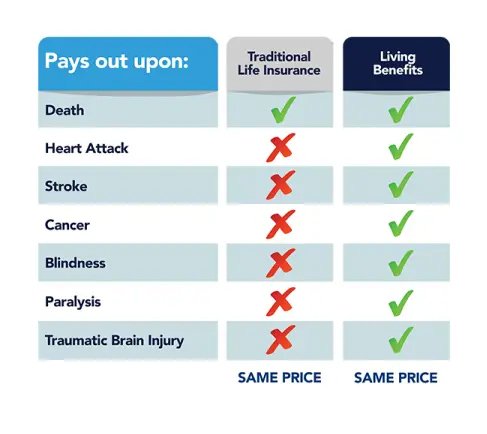
By having a policy with Living Benefits, you gain “early access” to the policy’s death benefit if you become seriously ill or injured during your lifetime.
How do Living Benefits work?
Living Benefits are built-in features that allow policyholders to access their death benefit “early” to get money in their hands when they need it most. If an insured party suffers and survives a heart attack, stroke, cancer, or other qualifying illnesses, they will have access to potentially hundreds of thousands of tax-free dollars, delivered straight to their bank account.
The best part? These Living Benefits come included at no extra cost!
Living Benefits: The Smartphones of Life Insurance
Are you still protecting your family and finances with the “old kind” of life insurance that only pays out if you die? Living Benefits life insurance is the new, evolved kind of life insurance. With Living Benefits, you have the power to accelerate your death benefit while you’re still living if you suffer a heart attack, cancer diagnosis, stroke, or any other Critical, Chronic, or Terminal illness. Living Benefits safeguard your family from the cause of 50% of the bankruptcies in the U.S. every year – medical bankruptcy following a critical illness.